- Pick what you need and give your kitchen's ZIP code.
- Each service goes to the number of local companies you choose, from one to five. We check licenses where the law requires one and email you their names.
- You talk with them and decide. You hire and pay the company directly.
Facts checked 2026-11-02.
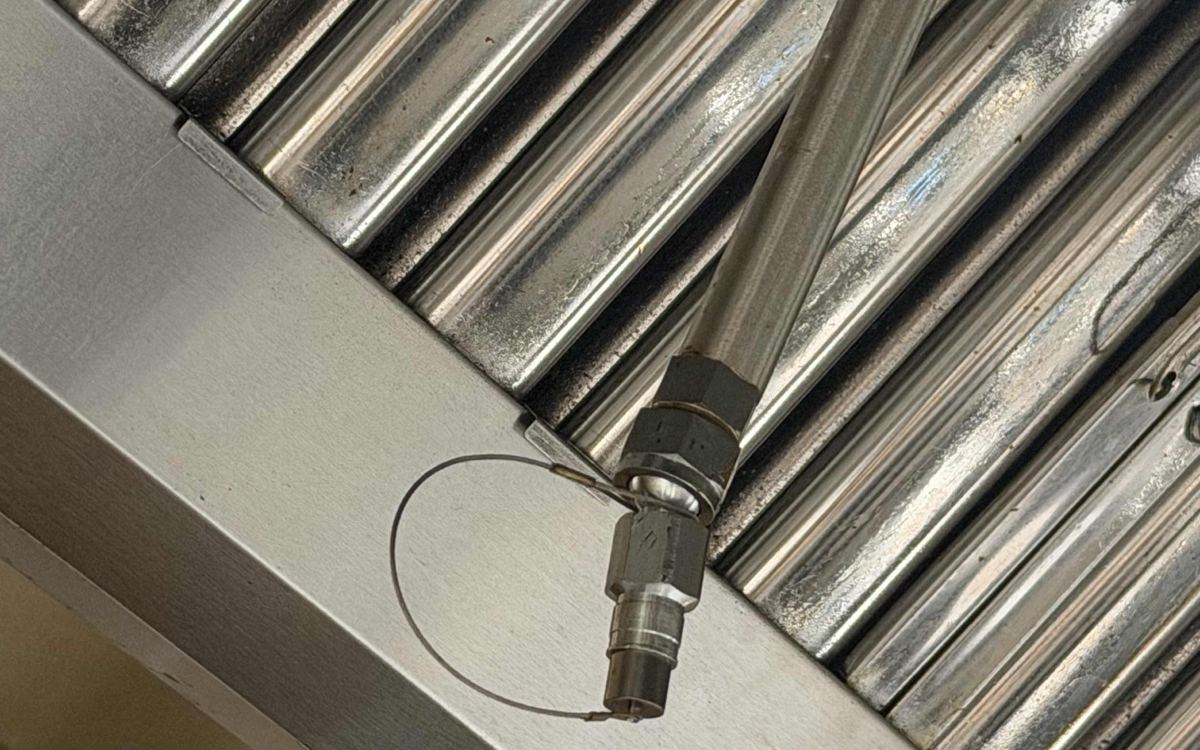
A restaurant's hood fire suppression system must be installed and serviced by a company the Texas State Fire Marshal's Office has registered, using technicians it has licensed. How often it is checked is set by the local fire marshal. Houston requires inspection and a new tag at least every 6 months.
What the system is
A pre-engineered system is a factory-designed set of parts, fusible links among them, that protects the cooking line and the hood. Texas fire rules require pre-engineered commercial cooking systems to meet the UL 300 test standard. A system installed or changed after July 1, 1996 had to meet it. Older systems had to meet it by January 1, 2008 or be red-tagged.
Who may service it in Texas
The State Fire Marshal's Office (SFMO) is part of the Texas Department of Insurance (TDI). It licenses individuals and registers companies.
| Who | What they may do |
|---|---|
| Company with a Fire Extinguisher Certificate of Registration | The business can install and service extinguishers and fixed systems |
| Type K licensee (Kitchen Cooking Systems) | Install, certify or service pre-engineered systems that protect a cooking area, plus portable extinguishers |
| Type A licensee (Fixed Systems) | Install, certify and service all pre-engineered fixed systems and portables |
| Apprentice permit holder | Work only under the direct supervision of a licensee, who signs every document |
A technician cannot hold a license unless a registered company employs them, and a company cannot be registered without a licensed employee. Technicians must be able to show proof of their license on the job. You can check a company or technician on TDI's company and licensee search.
A system that is not pre-engineered, such as a custom design, must be planned by a Type PL licensee or a professional engineer.
A local company can take it from here. One form, free for restaurants.
Get connectedService tags and red tags
After service, the technician attaches a tag. It reads "Do not remove by order of the State Fire Marshal." It shows the company name and registration number, the technician's name, license number and signature, the month and year, the work done and the owner's name. Only an authorized employee of a registered company, the SFMO or a regulating agency may remove it.
If a system is unsafe or will not work, the company must tell you in writing and tell the local fire authority within 24 hours. It then attaches a red tag that reads "DO NOT REMOVE--EQUIPMENT IMPAIRED." The authority also gets a written copy within three business days. A normal service tag goes on only after the problems are fixed and the system is checked again.
Under the state rules, a fusible link replaced during service must carry the manufacturer's date stamp, and the service tag lists the link's year of manufacture, temperature and quantity.
How often it is checked
The state rules adopt NFPA 17A, the national standard for wet chemical systems. Your local fire marshal sets the schedule you will be held to. Under the Houston Fire Department's standard, an approved fire protection equipment company inspects and service tags vent hood fire suppression systems at least every 6 months and after any activation. Gainesville's fire safety inspection page says kitchen fire suppression systems get a third-party inspection every 6 months.
Ask your fire marshal's office what it enforces and what proof it wants.
Installation, labels and permits
When a new system goes in, the licensee who certifies it must be present for the final test. A label goes on the control head or panel. The owner gets an installation certificate, and a copy goes to the local fire authority if it requires one.
Cities add their own rules. Midlothian asks for fuel gas and power to cooking appliances to shut off when the system trips. It also asks that the exhaust fan keep running and that the system tie into the building fire alarm if there is one. Dallas lists a fire permit for a commercial cooking fire-extinguishing system in its fee schedule. Houston's amended fire code requires the system to be listed for commercial cooking and installed to its listing, NFPA 96 and the maker's instructions.
What to ask a company before you hire
- Is the company registered with the State Fire Marshal's Office, and is the technician licensed as Type K or Type A?
- Will the technician attach the state service tag and explain what was done?
- Does the city need a permit, and who files it?
- If a part fails, will you get the red tag notice in writing?
For a Texas kitchen, a suppression install, change or inspection request on the form goes to one licensed local company.
Questions
How often does a restaurant fire suppression system need service in Texas?
It depends on the city. Houston requires inspection and tagging at least every 6 months and after any activation. Gainesville asks for a third-party check every 6 months. Ask your local fire marshal what applies at your address.
Does a fire suppression technician need a license in Texas?
Yes. Texas law allows only licensed technicians or apprentices working under one to install or service these systems, and the company must hold a state registration. A Type K or Type A license covers kitchen systems.
What does a red tag mean on a fire suppression system?
It means the system is unsafe or will not work. The company must tell the owner in writing and notify the local fire authority within 24 hours. The tag stays until the problems are fixed and the system is rechecked.
Does a kitchen fire suppression system have to be UL 300?
Yes for pre-engineered commercial cooking systems. Texas rules required it for systems installed or changed after July 1, 1996, and for existing ones by January 1, 2008.
Sources
- TDI, fire extinguisher registration, license and test information
- TDI, fire industry licensing
- 28 TAC 34.511, license types
- 28 TAC 34.512, apprentice permits
- 28 TAC 34.517, fixed system requirements
- 28 TAC 34.519, installation labels and certificates
- 28 TAC 34.520, service tags
- 28 TAC 34.521, red tags
- 28 TAC 34.507, adopted standards
- Houston Fire Department LSB Standard 02
- Houston amendments to the 2021 International Fire Code
- Gainesville fire safety inspection
- Midlothian Fire Marshal's Office, fire protection inspections
- Dallas Fire-Rescue schedule of permit fees